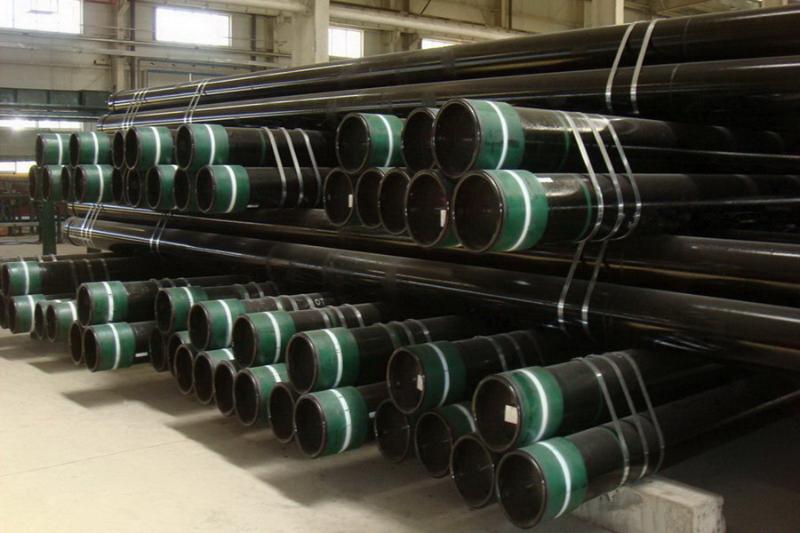
1. Overview of API Spec 5CT
API Spec 5CT (Specification for Casing and Tubing) is the globally recognized core standard issued by the
American Petroleum Institute (API) for Oil Country Tubular Goods (OCTG), covering seamless and electric-resistance-welded (ERW) steel casing, tubing, pup joints, couplings and matching accessories for onshore and offshore oil & gas wells.
It fully defines dimensional tolerances, steel grade metallurgy, mechanical performance, thread connection designs, manufacturing inspection, non-destructive testing (NDT), marking and delivery requirements. Its equivalent international standard is
ISO 11960, harmonized with API 5CT for cross-border oilfield procurement.
Three Product Specification Levels (PSL 1/2/3) are specified in the standard: PSL-1 for conventional shallow wells; PSL-2 with stricter chemical & NDT limits for medium-deep wells; PSL-3 with full enhanced testing for high-pressure high-temperature (HPHT) and sour gas wells.
2. Standard Specifications of Oil Casing
2.1 Outer Diameter (OD) Range
API 5CT standardized casing nominal outer diameters (imperial units as primary marking):
- Main range: 4½ in (114.3 mm) ~ 20 in (508 mm)
- Common mainstream sizes: 4½", 5½", 6⅝", 7", 7⅝", 8⅝", 9⅝", 10¾", 13⅜", 16", 20"
2.2 Nominal Weight & Wall Thickness
Each OD matches multiple nominal linear weights (lb/ft) and corresponding wall thicknesses (WT, inch/mm):
- Wall thickness scope: 0.280 in (7.11 mm) to 1.500 in (38.10 mm)
- Thicker walls deliver higher collapse resistance, burst strength and tensile load capacity for deep & high-pressure wells.
2.3 Standard Length Ranges (3 R Classifications)
All casing lengths are classified into three standard ranges for delivery:
- R1: 16 ft – 25 ft (4.88 m – 7.62 m)
- R2: 25 ft – 34 ft (7.62 m – 10.36 m) – most widely used for production casing
- R3: 34 ft – 48 ft (10.36 m – 14.63 m) – for deep well single joint deployment
2.4 API Standard Thread & Connection Types
Casing joints transfer tensile/compressive loads and seal formation pressure; three mainstream API thread forms are defined:
- STC (Short Round Thread Coupling)
8-round tapered thread, low cost, fast running speed. Limited tensile & sealing capacity, only for shallow low-pressure wells. - LTC (Long Round Thread Coupling)
Extended round thread, higher joint tensile efficiency and better sealing than STC. Universal for conventional production casing. - BTC (Buttress Thread Coupling)
Trapezoidal buttress tooth profile, outstanding collapse & compression resistance. Preferred for deep wells, heavy casing strings and salt dome formations.
For sour service / HPHT critical wells, premium metal-to-metal sealed connections (non-API proprietary threads) are allowed per supplementary SR requirements in API 5CT.
3. Material & Steel Grades under API 5CT
API 5CT categorizes casing steel grades by minimum yield strength (ksi, thousand pounds per square inch) and corrosion resistance, divided into four functional groups with strict chemical composition, hardness and mechanical property thresholds.
Group 1: General Service (Non-sour, Shallow to Medium Wells)
- H40: Min yield 40 ksi, lowest strength, only for surface shallow casing.
- J55 / K55: Min yield 55 ksi, low cost, for shallow vertical wells without H₂S corrosion; K55 has slightly higher tensile performance.
- N80 Type 1 / N80Q: Min yield 80 ksi. N80Q undergoes full quenching & tempering with superior toughness; suitable for medium-depth conventional wells, not for severe sour service.
- R95: Min yield 95 ksi, intermediate strength for moderate-depth wells.
Group 2: Sour Service Resistant (SSC Anti-Cracking for H₂S-bearing Wells)
Controlled maximum hardness (≤22 HRC) to avoid sulfide stress cracking:
- L80 Series (Min yield 80 ksi)
- L80 Type 1: Carbon-manganese steel for mild sour environments
- L80 3Cr / 9Cr / 13Cr: Chromium alloy grades with increasing CO₂/H₂S corrosion resistance for corrosive reservoirs
- C90: Min yield 90 ksi, low-hardness quenched-tempered steel for moderate sour gas wells
- T95: Min yield 95 ksi, balanced strength & anti-SSC performance for mid-deep sour wells
Group 3: High-Strength Deep Well Grade
- P110: Min yield 110 ksi, seamless high-strength steel. The most common grade for deep & high-pressure oil/gas wells; limited application in severe sour service without strict hardness control.
Group 4: Ultra-High Strength Extreme HPHT Grade
- C110: Sour-service qualified ultra-high strength (110 ksi yield), controlled hardness for deep sour wells
- Q125: Min yield 125 ksi, four sub-types (Q125-1 ~ Q125-4) with customized toughness for ultra-deep, ultra-high collapse pressure wells; forbidden for sour service due to high cracking risk.
Core Material Control Rules
- Chemical limits: Restrict carbon, manganese, phosphorus, sulfur and trace alloy elements to guarantee weldability, toughness and corrosion performance.
- Mechanical mandatory indexes: Minimum yield strength, tensile strength, elongation, reduction of area, full-scale Charpy impact toughness for low-temperature applications.
- Hardness caps: Sour-service grades (L80, C90, T95, C110) require maximum hardness ≤22 HRC to prevent sulfide stress cracking (SSC).
4. Associated Supporting Standards Linked with API 5CT
API 5CT works as the master specification, paired with complementary API standards for full lifecycle control of casing:
- API Spec 5B: Threading, gauging and inspection procedures for casing & tubing threads
- API RP 5A3: Standard thread compound requirements for sealing and thread anti-galling
- API RP 5B14: Thread protection, storage and handling guidelines
- API Q1: Quality management system certification for manufacturers to obtain API Monogram marking
- ISO 10893 series: International non-destructive testing standards referenced for ultrasonic, magnetic particle and hydrostatic inspection of casing pipes
5. Core Functional Requirements Specified in API 5CT
- Hydrostatic pressure test: Every casing joint must pass water pressure testing to verify burst resistance.
- Dimensional inspection: OD, wall thickness, length, drift diameter and thread dimension tolerance monitoring.
- NDT screening: Ultrasonic testing for wall defects; magnetic particle testing for surface cracks (mandatory for PSL-2 & PSL-3).
- Mechanical sampling: Tensile, hardness and impact test batches to validate steel grade compliance.
- Permanent marking: Each pipe marked with OD, weight, steel grade, heat number, PSL level, API monogram and manufacturer logo for full traceability.